
Imagine you’ve just started a small business in Sri Lanka – a café in Negombo, a boutique in Galle, or a service shop in Kandy. You know you need a website to reach more customers, but you’re juggling costs, local options, and the big question: where to start? The landscape has changed. You aren’t just choosing between “hiring a guy” or “doing it yourself” to create a website or web development in Sri Lanka. You now have AI agents that can build a site in minutes, no-code platforms that offer elite design, and Managed WordPress solutions that handle the heavy lifting.
Designing a practical, fast, and reliable website has become easier than ever before, especially when you combine local knowledge with modern tools and a touch of AI. Here’s a friendly, step‑by‑step guide to help you design a website in Sri Lanka that looks great, loads fast, and stays affordable.
Step 1: Define Your Strategic Purpose of Creating a Website
Before you decide on a colors or how your website should look, you must define the strategic foundation of your site. Without a clear purpose, your website becomes a “zombie site” – it exists, but it doesn’t perform. In Sri Lanka, your purpose must align with local infrastructure realities, financial ecosystems, and the evolving legal landscape.
1. The Information & Trust Anchor (Business Presence)
If your goal is to build credibility and drive foot traffic to a physical location, your strategy should prioritize:
- Local Trust Signals: Integration of Google Maps, verified contact details, and a professional .LK domain.
- Authority Building: Showcasing your expertise through local case studies and bilingual content (English/Sinhala/Tamil).
- Conversion Goal: Getting the user to call, message via WhatsApp, or visit your store.
2. The E-commerce Engine (Revenue Generation)
If you are selling products online, your website is your 24/7 salesperson. This strategy requires a heavy focus on:
- Localized Financial Ecosystems: Moving beyond just credit cards to include LankaQR, PayHere, and BNPL (Buy Now, Pay Later) options like Koko, which are essential for the Sri Lankan consumer.
- Frictionless Checkout: A design that works seamlessly on slow Internet connections to prevent halfway-abandoned orders.
- Conversion Goal: A completed payment and a signed up customer.
3. The “Mobile-First” Reality (Performance Strategy)
Around 70% of Sri Lankan users access the web via mobile data (4G/5G). If your strategic purpose is to reach the mass market, your site must be built for performance:
- Data Efficiency: Optimizing images and scripts so they don’t drain the user’s mobile data package.
- Speed as a Strategy: Utilizing Singapore-based hosting to ensure near-instant load times (under 2 seconds) even on fluctuating mobile connections (How fast will my website load?).
- Conversion Goal: Rapid engagement before the user loses patience or data connectivity.
4. The Compliance Foundation (Legal Strategy)
Under the Personal Data Protection Act (PDPA) No. 9 of 2022, a strategic purpose now includes being a “safe” destination. Your site must be designed to:
- Protect User Data: Clearly define how you handle local customer information to avoid fines.
- Build Long-term Credibility: Showing your customers that you value their privacy is a major competitive advantage in the current digital landscape.
The Bottom Line: Your strategic purpose dictates your budget, your hosting choice, and your technical requirements. By defining this first, you ensure that every Rupee spent on your website is an investment in a high-performing business asset.
Step 2: Pick a Path to Create Your Website
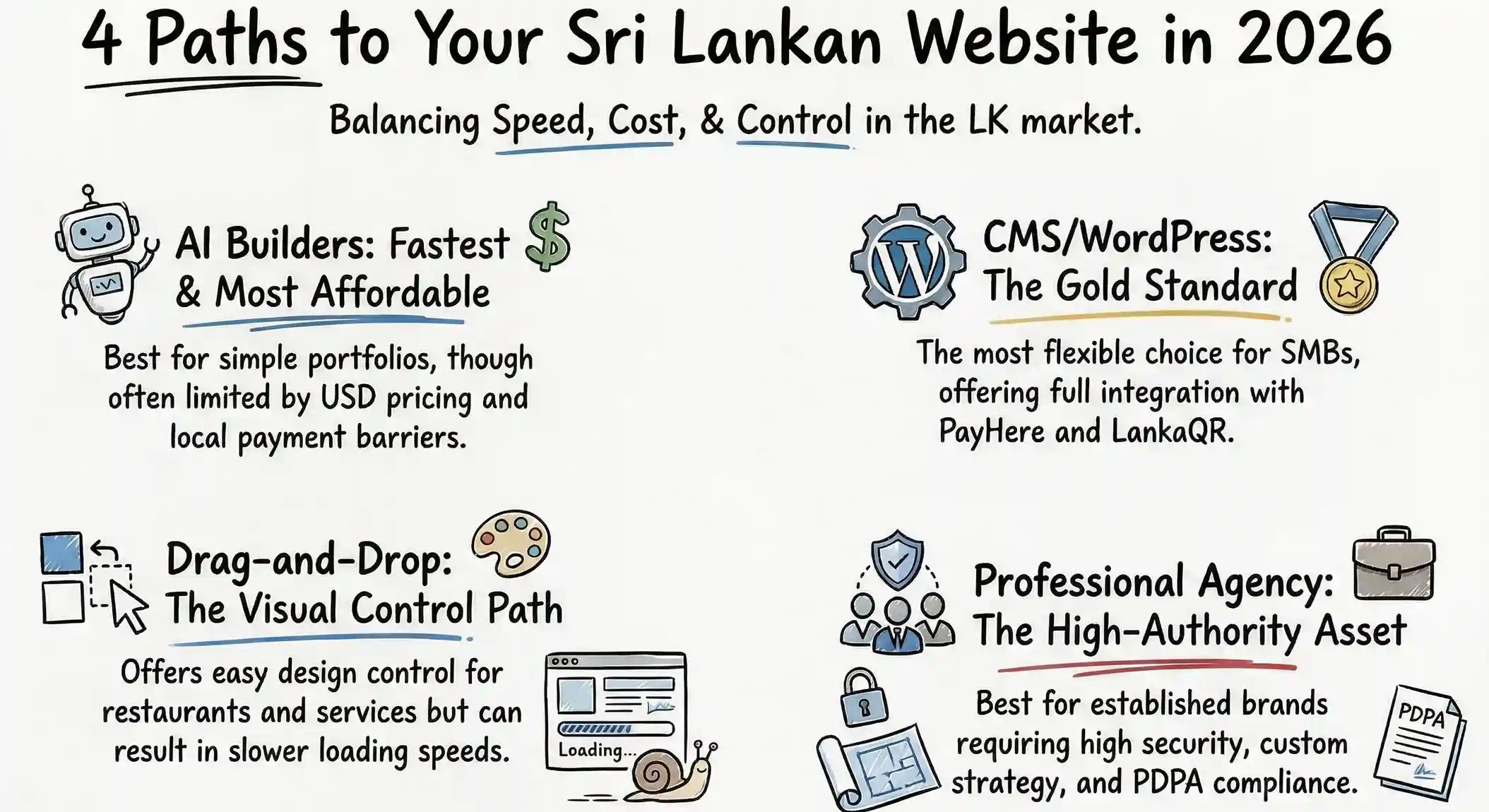
Choosing how to build your website is a strategic decision that affects your long-term costs, loading speeds, and ability to accept local payments. In the Sri Lankan market of 2026, you generally have three distinct directions. Each path offers a different balance of speed-to-market and technical control.
Path A: The AI Builder (Fastest & Most Affordable)
AI builders use generative algorithms to create a functional website layout in minutes based on a simple description of your business. It’s the “instant coffee” of web design – quick and convenient.
- Best for: Personal portfolios, digital business cards, or validating a new business idea with minimal investment. This is especially effective if you’ve chosen the “Information & Trust Anchor” or “Mobile-First Reality” paths as your website’s strategic purpose. You can quickly create fully responsive, fast, and informative websites with ease.
- The 2026 Reality: Tools like Wix ADI or Durable are incredibly great, but often feel overly complex due to feature bloat. On top of that, they charge in USD – meaning your monthly costs can fluctuate with exchange rates, which is especially challenging in Sri Lanka’s current economic climate. Even for more advanced users, generating a website with tools like ChatGPT or Claude is possible, but hosting and maintaining it can quickly become a headache due to dependencies and setup complexity. On top of that, making even small changes often means regenerating large parts of the site, rather than making simple, controlled updates.
- The Catch: Websites built for e-commerce or more advanced use cases using AI-generated code (“vibe-coded” apps) can introduce significant security risks. Without proper software engineering expertise, these tools produce code with vulnerabilities or hidden backdoors – making them unsuitable for handling complex or sensitive requirements. Global AI builders often lack native support for local necessities. If you need a LankaQR code for payments or PayHere integration, you may hit a “technical wall” that requires moving to a different platform.
Tip:
If you’re not a developer, relying on AI tools like ChatGPT or Claude to build a website or application directly is not recommended - it often leads to serious maintenance challenges and potential security risks down the line. After carefully evaluating how to simplify the process without compromising security or long-term maintainability, Provider.lk adopted a different approach with its AI website builder. We offer a simple, easy-to-use AI website builder that integrates seamlessly with .LK domain names and bills in LKR - giving you predictable, stable pricing. We’ve intentionally prioritized simplicity over unnecessary features, and targeted updates to specific pages or sections of a site.
Path B: The CMS / WordPress Path (The “Gold Standard”)
Content Management Systems (CMS) like WordPress offer a middle ground: they are user-friendly enough for techies and powerful enough for large enterprises. This is the most popular choice in Sri Lanka because of its massive flexibility.
- Best for: Small to Medium Businesses (SMBs), professional blogs, and high-performance WooCommerce stores (Building a WooCommerce Store in Sri Lanka?). This approach works across all the strategic paths for creating a website.
- Local Ecosystem Advantage: This is the only path that allows full, seamless integration with the complete Sri Lankan financial stack, including PayHere, LankaQR, and Koko (BNPL).
- Performance Optimization: When paired with Managed WordPress hosting optimized and dedicated only for WordPress, these sites achieve elite speeds by stripping away “server bloat” (unnecessary background languages like Python or Ruby) and focusing entirely on WordPress delivery.
- The Catch: There is a slight learning curve. While you don’t need to code, you will need to spend time (or hire a professional) to configure your site and plugins correctly. It requires a certain level of technical expertise to customize and extend WordPress to meet your specific needs.
Path C: The Drag-and-Drop Builder (The Visual Control Path)
Drag-and-drop builders give you a visual, block-based way to create pages without coding. You can place sections, images, text, buttons, and forms exactly where you want them – making this the “presentation software” approach to website creation.
- Best for: Small businesses, service providers, restaurants, event websites, and anyone who wants more design control than an AI builder without the complexity of WordPress. This works especially well if you’ve chosen the “Information & Trust Anchor” or “Mobile-First Reality” paths as your website’s strategic purpose.
- The 2026 Reality: Drag-and-drop builders are popular because they are easy to understand and allow non-technical users to build polished websites visually. They are often faster to edit than AI-generated websites because you can change specific sections manually without regenerating the whole site. For many Sri Lankan businesses, this makes them a practical middle ground between AI builders and WordPress.
- The Catch: This convenience often comes with trade-offs. Many drag-and-drop builders generate heavier code, which can affect loading speeds and Core Web Vitals if not properly optimized. They can also become restrictive when you need advanced integrations, custom workflows, or local payment support such as PayHere, LankaQR, or other Sri Lankan-specific requirements. As your business grows, you may eventually outgrow the platform and need to migrate.
If you’re still deciding between WordPress or a drag-and-drop site builder, we’ve broken down the options for Sri Lankans in our comprehensive guide: Choosing the Right Platform to Build Your Website.
Tip:
Provider.lk’s AI website builder strikes the perfect balance between automation and control. While it can generate a complete website in minutes, it also allows you to visually edit and add specific sections -similar to working in presentation mode, so you’re not locked into rigid, all-or-nothing changes. This means you get the speed of AI with the flexibility to make precise, intentional updates whenever you need.
Path D: Hiring a Professional Agency or Freelancer (The High-Authority Path)
This path involves outsourcing the strategy, design, and technical heavy lifting to experts. It is less about “buying a website” and more about “investing in a business asset.”
- Best for: Established brands, complex e-commerce operations, and organizations that must prioritize PDPA (Data Protection) compliance.
- Strategic Depth: A professional agency doesn’t just make it “look pretty.” They conduct Entity Gap Analysis to ensure you outrank competitors and build a “legal fortress” around your customer data to prevent data breaches.
- The Catch: This requires the highest upfront investment. However, it results in a custom-coded, high-security asset that belongs entirely to you, without the recurring “subscription traps” found in global builders.
Tip:
Even if you choose to work with a professional agency or freelancer, you can still register your .LK domain and host your website on Provider.lk’s high-performance, Singapore-based cloud infrastructure with direct connectivity to local ISPs - ensuring excellent availability and reliability. For more advanced needs, eCloud.lk offer highly available Cloud VPS solutions, giving you the flexibility to host custom applications tailored to your specific requirements.
Comparative Platform Matrix for the Sri Lankan Website Designing Market
| Feature | AI Website Builder | Drag-and-drop Builder | WordPress | Custom Development |
| Ease of Use | Very Easy; simply chat with AI | Easy; Drag-and-drop | Moderate; learning curve | Difficult; requires coding |
| LKR Billing | Not supported by international providers (USD only), Provider.lk support LKR billing | Not supported by international providers (USD only), Provider.lk support LKR billing | Local providers including Provider.lk support LKR billing | N/A (Developer fees) |
| Payment Gateways | No support | Limited depending on the builder | Supported through plugins | Supported through payment gateway APIs |
| Maintenance | Minimal; handled by platform | Minimal; handled by platform | Requires regular updates (Managed WordPress hosting makes it easier for you with auto updates and patching) | Requires developer care |
| Scalability | Limited for complex sites | Limited for complex sites | High, via plugins and hosting | Very High |
| Initial Cost | Monthly subscription | Monthly subscription | Low (Domain + Hosting) | High (Developer fees) |
Step 3: Design Your Website and Your User Experience
This phase is where your “Strategic Purpose” meets the user’s reality. Now that you have chosen your path (WordPress, AI, or Custom), you must apply these high-authority design pillars to ensure your site performs in the local market.
1. The Mobile-First Mandate
Do not design for a desktop and “shrink” it for mobile. In the Sri Lankan context, the smartphone is the primary screen.
- Thumb-Friendly Navigation: Ensure buttons and Call-to-Action (CTA) elements are large enough to tap easily on a mobile screen.
- Data-Light Assets: Use modern image formats like WebP and avoid heavy background videos that drain a user’s mobile data quota.
- Speed-Centric Layouts: A clean design reduces the “Document Object Model” (DOM) size, helping your site load in under 2 seconds on a Dialog or SLT-Mobitel connection.
2. Localized User Interface (UI) & Language
To dominate the Sri Lankan market, your design must speak the local language-literally and culturally.
- Multilingual Support: Incorporate a clear language switcher for English, Sinhala, and Tamil. This significantly boosts your local SEO and makes your business accessible to the entire island.
- Visual Cues: Use imagery that resonates with the local context. Authentic local photography beats generic global stock photos when building trust with a Sri Lankan audience.
- WhatsApp Integration: In Sri Lanka, a WhatsApp chat bubble is often the highest-converting design element. Ensure it is visible but non-intrusive on every page.
Tip:
With Provider.lk’s AI website builder, you can instantly create fast, SEO-optimized websites in English, Sinhala, or Tamil - making it easy to connect with your audience in their preferred language without additional setup or complexity. Our platform is fully optimized to deliver mobile-first websites that meet modern industry performance and usability standards.
3. Trust Signals & Credibility Anchors
In a digital landscape wary of security risks, your design must visually communicate reliability.
- The .LK Identity: Feature your .LK domain prominently in your footer or “About” section. It acts as a digital “seal of approval” from the national registry.
- Contact Transparency: Include a Google Maps embed of your Sri Lankan office and a local landline number. This builds “brick-and-mortar” trust that global-only sites lack.
- Payment Logos: Display recognized local payment partner logos (PayHere, LankaQR, Koko) near your checkout or footer to reassure users their transactions are secure.
4. PDPA-Compliant Data Collection
Design your forms with the Personal Data Protection Act (PDPA) in mind to avoid potential Rs. 10 million LKR fines.
- Privacy by Design: Only ask for the data you absolutely need (e.g., don’t ask for an NIC number if you only need an email).
- Clear Consent: Ensure your “Contact” or “Sign Up” forms include an un-ticked checkbox for users to agree to your privacy policy before submitting data.
5. Conversion Path Optimization
Every design element should lead the user toward your strategic goal-whether that’s a sale or a lead.
- The “3-Click Rule”: A user should be able to find a product or contact you within three clicks from the homepage.
- Localized CTAs: Use action-oriented language that resonates locally, such as “Island-wide Delivery Available” or “Visit our Colombo Showroom.”
Real-World Web Development Pricing in LKR (2026 Estimates)
Based on current market rates in Sri Lanka, here’s a realistic budget range for a professional website. These figures are general estimates and may vary depending on the service provider, project scope, and changing market conditions.
| Component | AI Site Builder | Professional (Freelancer) | Agency (Custom) |
| Domain (.LK) | Rs. 5,000 LKR | Rs. 5,000 – 10,000 LKR | Included/Managed |
| Hosting (Annual) | Rs. 20,000 – 100,000 LKR (inclusive of AI credits/platform fees in addition to hosting) | Rs. 15,000 – 25,000 LKR | Rs. 30,000+ LKR |
| Design/Dev Fee | Rs. 0 LKR (Your time) | Rs. 20,000 – 100,000 LKR | Rs. 150,000 – 500,000+ LKR |
| Total Startup | Rs. 25,000 – 105,000 LKR | Rs. 40,000 – 135,000 LKR | Rs. 180,000+ LKR |
Conclusion & Next Steps
Designing a website in Sri Lanka doesn’t have to be complicated. Whether you use an AI builder for a quick launch or hire a professional for a fully customized WooCommerce store, the foundation remains the same: fast hosting and a trusted local domain.
If speed-to-market is your priority, Provider.lk’s AI website builder is the fastest way to get online in Sri Lanka. You can generate a complete website in minutes and still have the flexibility to visually edit and refine specific sections for the first time in Sri Lanka with Provider.lk – giving you the perfect balance between automation and control.
Start with the approach that matches your current needs, but build on a foundation that can grow with your business.