
Sri Lankan Web Hosting Company and LK Domain Registration Provider
LK Domain Registration Requirements: Key Rules, Eligibility Criteria & Compliance Overview
What are the Primary Requirements for Registering an LK Domain in Sri Lanka?
The Role of the LK Domain Registry and the Registrant
LK Domain Restrictions: Rules, Reserved Names, and Eligibility Requirements Explained
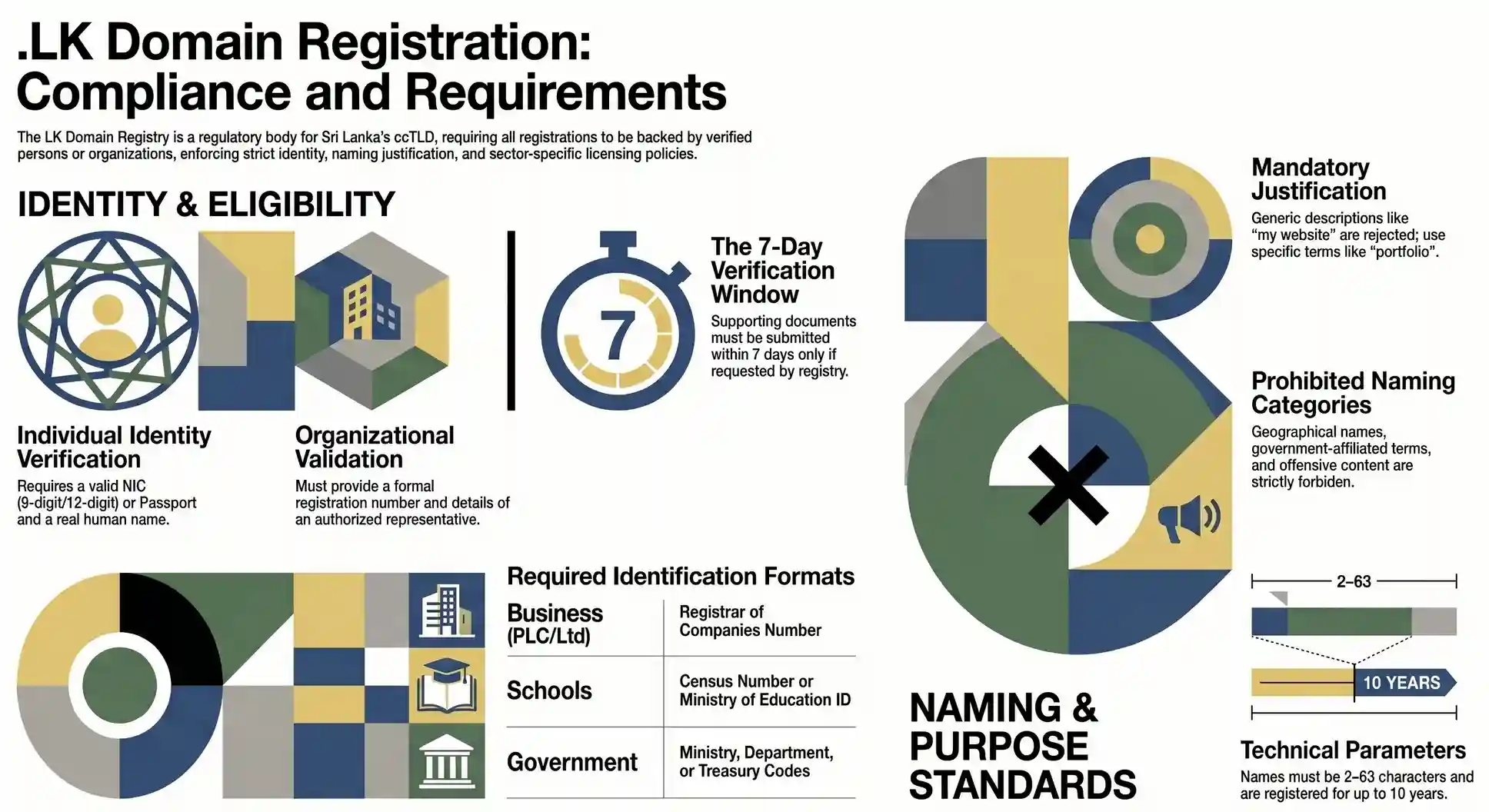
The .LK domain has strict registration rules covering name length, eligibility, and restricted terms. Domains must be 2–63 characters, registered on a first-come-first-served basis, and may be held for up to 10 years. Certain categories like .gov.lk, .edu.lk, and .sch.lk are limited to approved institutions, while regulated sectors may require official documentation.
Beyond these basics, several naming restrictions apply. Reserved or restricted domain names cannot be registered. Names that imply affiliation with the government, ministries, municipalities, or statutory bodies are prohibited unless supported by valid evidence. Personal names are generally not allowed unless they serve a legitimate professional purpose, such as for artists, consultants, or public figures with a clear use case.
Geographical names including countries, cities, provinces, and their abbreviations (e.g., colombo.lk or cmb.lk), are not permitted. Additionally, domain names must not be offensive, obscene, or misleading in relation to Sri Lanka’s religions, cultures, genders, or communities.
For activities requiring government licensing, such as banking, insurance, liquor, or gambling, applicants must provide valid licenses and supporting documentation. Similarly, domains containing trademarks or well-known brand names require proof of legal ownership or authorized use, ensuring alignment with the applicant’s organization details.
Can a Foreigner Register a LK Domain Without a Local Presence?
Mandatory Requirements for Individual Domain Registrants
For individual applicants, .LK domain registration requires accurate personal details including a valid full name, a complete postal address, a working email, and a phone number in a recognized format. Applicants must also provide a valid NIC or passport number for identification purposes. Organization details are generally not required unless the domain purpose indicates a business or institutional use. No supporting documents are needed at the time of registration; however, the registry may request verification documents if necessary, and these must be provided within 7 days if requested.
Each applicant must provide valid personal details, including an valid NIC or passport number. Old NICs must follow the correct format (9 digits followed by “V” or “X”), while new NICs must contain 12 numeric digits. Passport numbers must also follow standard international formatting rules. Providing a copy of your identification document is not required at the time of registration. However, the registry reserves the right to request supporting identification documents if needed for verification or compliance purposes, particularly in cases where additional clarification is required. If such a request is made, the registrant must submit the requested documents within 7 days. Failure to provide the required documentation within this timeframe may result in deregistration of the domain to ensure compliance with registry policies and maintain the integrity of the .LK domain space.
The registrant name must be a real human name (First Name + Last Name) and cannot represent a company or organization. Email addresses must be properly formatted and cannot use disposable domains, while phone numbers must follow valid international or Sri Lanka formats. A complete and realistic postal address is also required.
The domain purpose must be meaningful and specific. Generic descriptions such as “my website” or “create a website” are not acceptable. Acceptable examples include “portfolio website” or “personal photography showcase.”
Mandatory Requirements for Organizations/Businesses
Organization and business related .LK domain registrations require additional information beyond individual applications. The core requirements include a valid organization name, a registration number, a registered address, and appropriate organizational contact details. In addition, if organization details are not provided in the application, but the stated purpose includes terms such as “company,” “business,” “organization,” “school,” or “university,” additional organizational information may be required.
Small-scale or informal businesses may be exempt from providing organization details where the domain clearly reflects a personal or limited-scope activity (for example, niche creative services or individual portfolios). However, such cases are assessed individually to ensure the domain purpose and naming remain consistent with registry requirements.
The organization name must be legitimate and cannot contain placeholders such as “Test,” “ABC,” or “Sample.” The registration number must also follow a valid, structured format, as outlined below:
a. Business Registration Numbers in Sri Lanka
b. School Registration Number
For schools, one of the following official identifiers must be provided:
- School Census Number
- School Code
- Ministry of Education School ID
These identifiers confirm that the institution is formally recognised within the national education system.
c. Government Bodies and Official Institutions
Government organizations operate under structured identification systems depending on their administrative and financial functions:
- Ministry and Department Codes: These are assigned to all ministries and departments for administrative classification, record-keeping, and internal government operations.
- Treasury and Finance Codes: Used in national budgeting and public finance systems, these codes link institutions to salary payments, funding allocations, and expenditure tracking.
Statutory Body Registration Numbers: Issued to state corporations, boards, and authorities established by Acts of Parliament. These ensure legal recognition, governance, and accountability.
- Procurement and E-Government IDs: Used across government procurement platforms and digital systems to identify institutions in tenders, contracts, and vendor management processes.
d. Higher Educational Institutes & Universities
Higher educational institutes and universities must provide official proof of recognition issued by the relevant governing authority. This may vary depending on the type of institution.
For public universities, which are established under Acts of Parliament, the primary identification is typically a statutory reference linked to the establishing legislation, along with internal institutional or ministry-issued codes used for administrative, financial, and governmental processes.
For private universities and degree-awarding institutions, recognition is generally granted by the University Grants Commission (UGC) or another authorised regulatory body. These institutions must provide their official approval or registration number issued by the relevant authority.
Do I Need to Submit Additional Supporting Documents?
Register Your LK Domain with Provider.lk
Start now and get your .LK domain live in minutes with Provider.lk