
Sri Lankan Web Hosting Company and LK Domain Registration Provider
The Role of the LK Domain Registry and the DNS Infrastructure
Key Takeaways: The LK Domain Ecosystem at a Glance
- Official Authority: Managed by the LK Domain Registry under ICANN/IANA delegation, ensuring your domain is a globally recognized asset.
- National Sovereignty: A non-profit infrastructure focused on Sri Lanka’s digital independence and 100% network uptime.
- Technical Excellence: Powered by a redundant nameserver network (local and global) for sub-second latency and failover protection.
- Trademark Protection: The registry enforces a strict Dispute Resolution Policy that prevents "bad faith" registrations, ensuring that trademark owners can reclaim names.
- Anti-Speculation Rules: To maintain the integrity of the national namespace, the reselling of .LK domains for profit is strictly prohibited, with transfers only permitted for legitimate purposes.
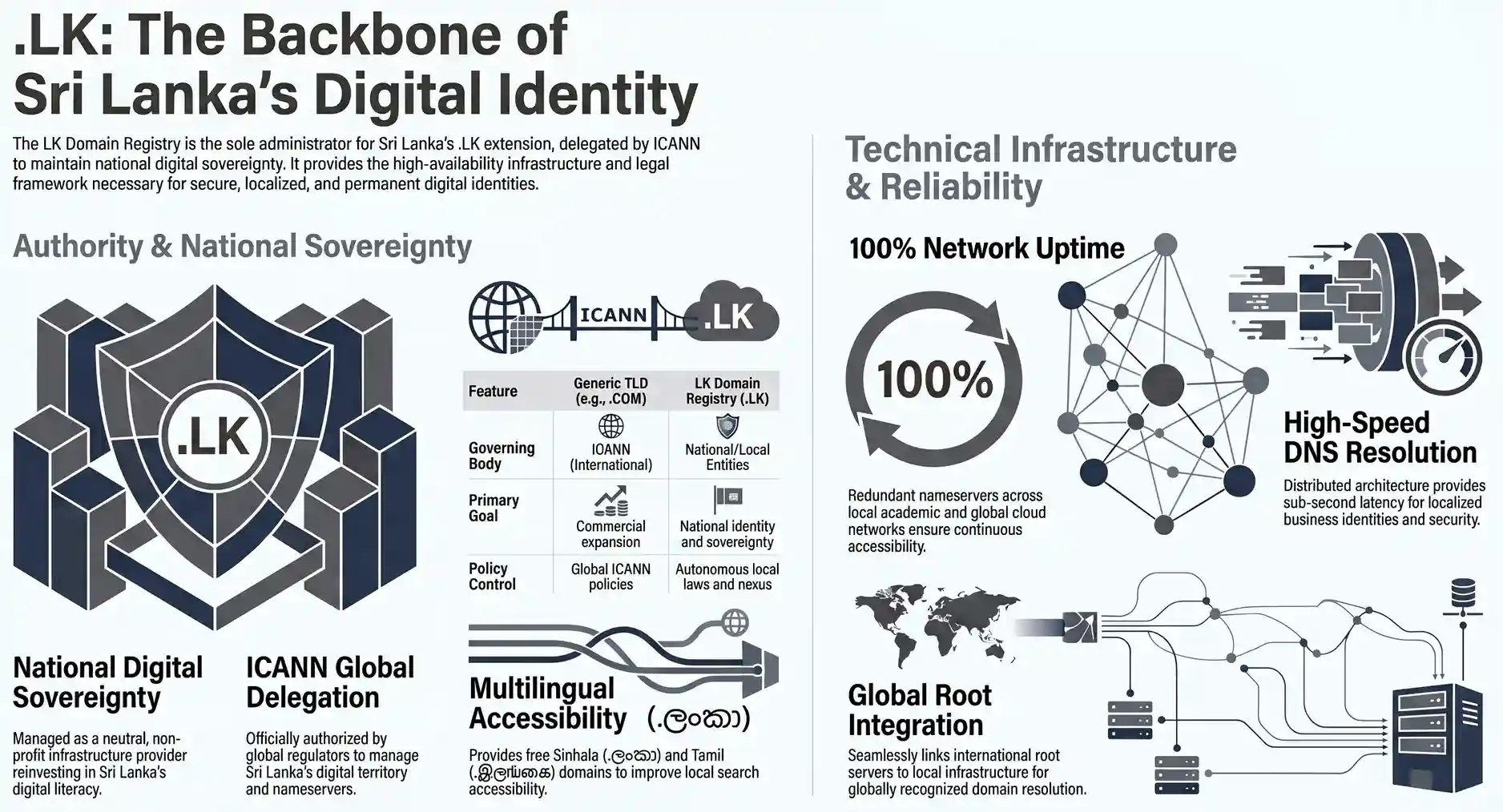
The LK Domain Registry is the official administrator of Sri Lanka’s .LK extension, delegated by ICANN and IANA to ensure national digital sovereignty. It manages the critical DNS infrastructure and top-level nameservers required for global domain resolution. This centralized governance provides the 100% reliability, localized security, and sub-second latency essential for Sri Lankan business identities.
The evolution of the .LK domain space is more than just a history of localized extensions; it is a narrative of technological independence. By maintaining a high-availability network and strict regulatory standards, the registry ensures that every .LK address is a trusted, permanent anchor for the nation’s digital economy within the global internet ecosystem. As an authorized registrar agent, Provider.lk simplifies the complexity of registry governance, offering a seamless LK domain registration and management interface to leverage the reliability and prestige of the .LK domain space.
Understanding the Role of a Domain Registry
A domain registry is the central database and authoritative “source of truth” for all domain names within a specific extension. Managed by a designated organization, the registry is responsible for maintaining the master file of registered domains, managing the nameservers that point traffic to the correct IP addresses, and setting the policies for how those domains are issued.
While every registry serves as a master database, the governing frameworks and technical mandates shift significantly when moving from generic Top-Level Domains (gTLDs) like .COM or .NET to country-code Top-Level Domains (ccTLDs) such as .LK, which prioritize national digital sovereignty.
The table below covers the difference between the registries of a generic TLD and the LK Domain Registry;
| Feature | Generic TLD (gTLD) | Country Code TLD (ccTLD) |
| Examples | .COM, .NET, .ORG, .CLOUD | .LK (Sri Lanka), .UK, .SG |
| Governing Body | Primarily ICANN (International) | National Governments or Local Entities |
| Primary Goal | Commercial expansion and global use | National digital identity and sovereignty |
| Policy Control | Subject to uniform global ICANN policies | Autonomous local policies and legal Nexus |
| Nexus Requirement | Open to anyone worldwide | Though .LK is an open extension allowing international registration, most ccTLDs require a local presence or residency |
Review the full .LK Registration Requirements and eligibility guidelines
The History and the Role of the LK Domain Registry
The LK Domain Registry began in 1990 as a visionary academic project within the Department of Computer Science and Engineering at the University of Moratuwa. Originally operated by Prof. Gihan Dias to provide Sri Lanka with its first independent digital identity, the registry’s rapid growth led to its transition into an independent, non-profit organization (a company limited by guarantee) in 2004. This shift ensured that the registry could remain a neutral, national infrastructure provider, reinvesting its surplus into the security and literacy of the Sri Lankan web rather than commercial profit.
For a .LK domain owner, the LK Domain Registry is the ultimate authority that guarantees your website’s existence and global reach. By managing the .LK ccTLD and a high-availability DNS infrastructure, the registry ensures your digital identity is secure, locally recognized, and always reachable. This centralized governance provides the 100% uptime and localized support required for professional business continuity.
Domain Names and DNS: Understanding the Basics
The DNS (Domain Name System) is the internet’s global directory that translates human-friendly domain names into machine-readable IP addresses. This process begins at the Root Zone, the highest level of the internet hierarchy, which directs traffic to specific TLD registries like .LK or .COM. By managing these technical “pointers,” the registry ensures your website is accurately located and resolved by browsers worldwide.
To understand how your website actually loads, think of the process as a relay race of information. It starts at the Root Servers, which act as the master switchboard of the internet; they don’t know your specific website, but they know exactly where the .LK Registry is located. Once a request reaches the LK Domain Registry, their infrastructure takes over. When you register a domain through a registrar like Provider.lk, the registry creates an official record in their database and “delegates” that name to you. They do this by setting your specific nameservers, which tell the global network exactly which hosting server holds your website’s files. Refer to our complete guide on pointing your .LK domain to a website.
This seamless chain, from the global Root to the local Registry and finally to your individual domain, is what allows a customer anywhere on earth to find your business in milliseconds. With this context, we can look into how an LK domain works.
How an LK Domain Works?
The LK Domain Registry operates under a formal delegation from ICANN and IANA, integrating Sri Lanka’s .LK ccTLD into the Global Root Zone. This international mandate ensures that every .LK domain is recognized by the world’s top-level nameservers, providing the technical legitimacy needed for global interoperability. By following these universal protocols, the registry guarantees your website is accessible from any network worldwide.
This means your .LK address is much more than a local label; it is a globally authenticated asset. ICANN (the Internet Corporation for Assigned Names and Numbers) acts as the global regulator of the web, and they have officially “delegated” the authority to manage Sri Lanka’s digital territory to the LK Domain Registry. This delegation is the reason your website appears in the global “phone book” of the internet. Because the registry maintains this high-level relationship with international bodies, your business benefits from a domain extension that is technically equal to a .COM or .ORG, but with the added protection and specialized focus of a national infrastructure partner.
The Core LK Nameserver Infrastructure and Technical Assignments
The LK Domain Registry ensures DNS infrastructure reliability by distributing the .LK root zone across multiple authoritative nameservers. By mixing local academic networks with international hosting environments, the registry prevents a single point of failure. This redundant architecture guarantees that your website remains reachable and resolves globally with sub-second latency and 100% uptime.
In other words, the registry doesn’t put all its eggs in one basket. To make sure your website never “disappears” from the internet, the records for every .LK domain are mirrored across several high-available servers located in Sri Lanka and around the world. By using a blend of trusted university networks and global cloud infrastructure, the registry creates a safety net. If one server goes offline or face a local outage, the others immediately take over. For you as a business owner, this means your “digital storefront” stays open and accessible to customers regardless of technical hiccups in any single location.
The table below covers the registry level nameservers maintained by the LK Domain Registry along with the respective IPv4/IPv6 addresses;
| Host Name | IP Address(es) |
|---|---|
| d.nic.lk | 123.231.6.18 2402:4000:479:c5:0:0:0:a |
| h.nic.lk | 43.252.12.206 2404:8a00:0:a00:0:0:0:4005 |
| m.nic.lk | 202.129.235.229 2407:c00:21:8:202:129:235:229 |
| ns1.ac.lk | 192.248.1.162 2401:dd00:1:0:0:0:0:162 |
| p.nic.lk | 204.61.216.27 2001:500:14:6027:ad:0:0:1 |
| pendragon.cs.purdue.edu | 128.10.2.5 |
| t.nic.lk | 203.94.66.129 2402:d000:100c:0:0:0:0:129 |
| z.nic.lk | 185.38.108.108 2a00:fea0:dead:0:0:0:0:beef |
Policy and Compliance: The Registry’s Dispute Resolution
All .LK domains are governed by the LK Domain Registry’s Registration Policy, which includes a specialized Dispute Resolution Policy (DRP). Unlike the standardized ICANN UDRP used for .COM names, the .LK DRP is aligned with Sri Lankan Law, providing a faster and more relevant legal framework for resolving trademark conflicts or “cybersquatting” issues within the island.
For a domain owner, this policy framework acts as your legal insurance. The registry maintains a “Source of Truth” that protects legitimate trademark holders from bad actors. If someone registers a name that infringes on your business rights, the registry’s localized dispute process allows for a structured resolution without the massive costs of international litigation. Furthermore, the registry enforces ethical usage policies, meaning they can de-register domains used for illegal activities. This active governance ensures that the .LK neighborhood remains “clean,” enhancing the trust and credibility of every business that calls it home.
Protection Against Cybersquatting and Domain Infringement
Because the LK Domain Registry requires a Justification Statement and identity verification (NIC or BR number), “cybersquatting”—the practice of squatting on someone else’s brand name—is significantly lower than in gTLDs. The registry’s post-registration manual review process acts as a preventative security layer, ensuring that applicants have a legitimate right or a non-malicious reason for choosing a specific domain name.
Every LK domain registration is vetted against existing policies to ensure it doesn’t “grossly mislead” the public. If an infringement does occur, the registry’s Dispute Resolution Policy (DRP) provides a local legal path to recover your name without needing to navigate international courts. For a domain owner, this means your brand is protected by a “Circle of Trust” that values legal accountability over anonymous, high-volume registrations. This protection has a direct impact on the transfer and reselling rules as discussed below.
Transfer and Reselling Policies: Rules on Ownership
The LK Domain Registry strictly prohibits the reselling or trading of domain names for profit, reinforcing its mission as a non-profit national infrastructure. While domain owners have the right to use a name, they do not “own” it as a commodity to be auctioned. Domain transfers are permitted only under specific legal circumstances, such as corporate mergers, acquisitions, or official rebranding, ensuring the namespace remains stable and non-speculative.
In practical terms, this means you cannot buy a .LK domain solely to list it for sale on a marketplace. If a registrant is found publishing advertisements to resell a domain, the registry reserves the right to de-register the name immediately. When a legitimate transfer is required—for example, if you sell your business to a new owner—the process involves a formal request to the registry with supporting documentation. By preventing “domain squatting,” the registry ensures that valuable names remain available for actual businesses and organizations at standard prices, rather than being held hostage by speculators. This policy maintains the prestige and accessibility of the .LK extension for all legitimate Sri Lankan entities.
Navigating the LK Ecosystem through Provider.lk
The LK Domain Registry manages the technical foundation, but Provider.lk serves as your dedicated gateway to that infrastructure. We simplify the domain lifecycle management by handling the technical liaison with the registry, ensuring your nameserver configuration and renewal processes are seamless. This partnership allows you to leverage national digital sovereignty with the support of a specialized service interface.
Start now and manage your .LK domain seamlessly in minutes with Provider.lk